Under review · anonymous submission

PlugV2V: A Plug-In Vision-Language-Model-Based Semantic Cooperation Agent for Autonomous Driving

Cooperation added to a driving stack it knows nothing about — through an interface four values wide, at one thirtieth of the control rate, with no retraining.

Watch demos Paper — under review Code — on acceptance

Authors and affiliations withheld for double-blind review.

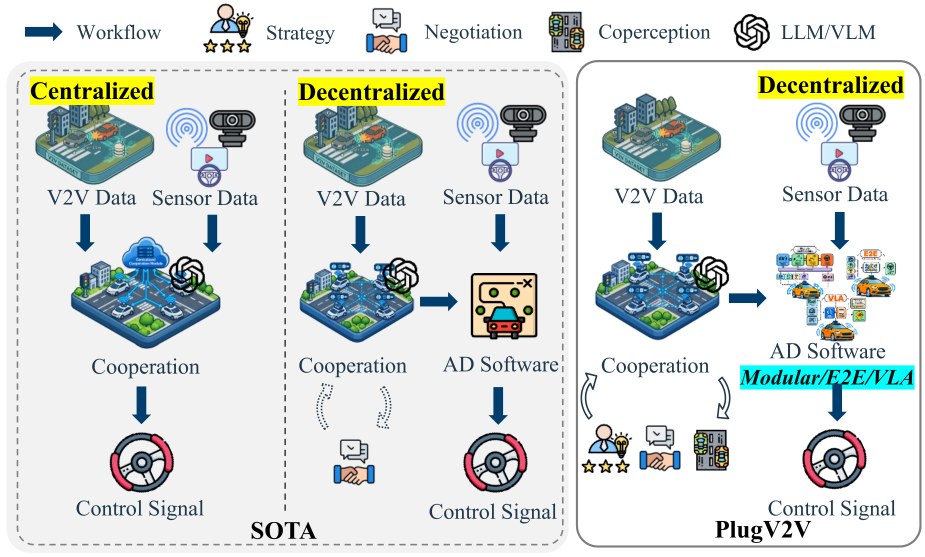
Centralized, decentralized, and PlugV2V approaches to language-based V2V cooperation compared.
Three ways to coordinate. Left: centralized methods aggregate vehicle data in one coordinator that decides for all vehicles. Center: decentralized methods negotiate among vehicles, but execute the agreement through one fixed driving stack. Right: PlugV2V combines decentralized negotiation, strategy knowledge and shared observations, while the same agreement interfaces with modular, end-to-end and vision-language-action stacks.
01 — Abstract

Cooperation as a low-rate semantic layer

TL;DR

A vision-language model fuses compact V2V messages with each vehicle's own cameras, groups the vehicles that actually conflict, and lets each group negotiate a passing order. The agreement leaves as one of four target-speed tokens, so the same agent supervises a rule-based planner, an end-to-end model and a vision-language-action model without retraining any of them.

Interactive traffic requires vehicles to coordinate passing order, merging gaps and yielding behaviour, yet existing language-based cooperation methods provide only part of the required cooperation stack and are typically tied to a single driving backend. They rarely combine ego-centric cooperative observations, explicit strategy knowledge, multi-agent negotiation and bounded execution within one framework.

We present PlugV2V, a backend-agnostic plug-in/plug-out semantic V2V cooperation agent that uses a vision-language model to fuse compact V2V state messages with local camera observations, form conflict groups, and negotiate schema-checked target-speed actions at low frequency while the host driving stack retains high-frequency control. Lightweight backend adapters connect the same agent to rule-based, end-to-end and vision-language-action driving stacks.

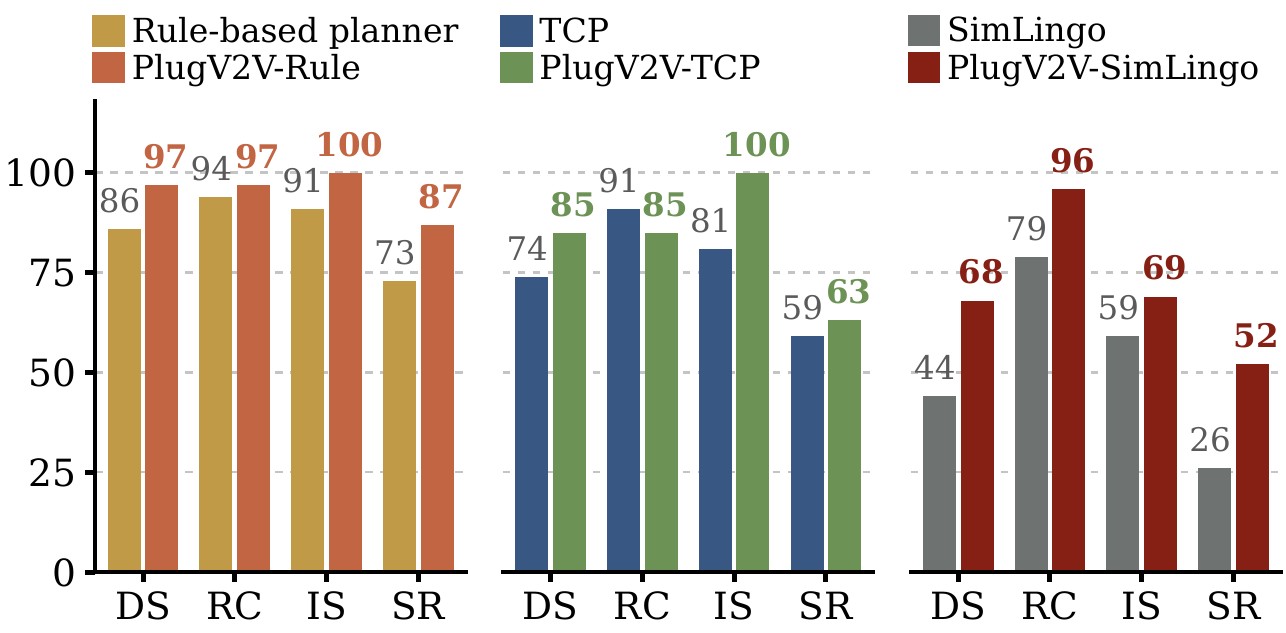
On the 46-route CARLA InterDrive benchmark, cooperative observations, strategy knowledge and negotiation provide complementary gains, together improving the driving score of a rule-based planner from 85.72 to 96.57. PlugV2V also outperforms the strongest reported method on the same benchmark in both evaluation modes, with and without non-communicating traffic, exceeding the previous best by 6.45 and 4.04 driving-score points. Across heterogeneous backends it improves rule-based, end-to-end and vision-language-action stacks by approximately 11, 11 and 24 points respectively.
02 — Contributions

Three things this paper adds

01

A semantic cooperation agent

A vision-language model combines multi-vehicle observations, explicit strategy knowledge, conflict grouping and bounded negotiation to produce schema-checked group agreements — decentralised, with no roadside unit and no central planner.

02

A plug-in/plug-out interface

Four target-speed tokens and a small per-backend adapter. The same agent supervises rule-based, end-to-end and vision-language-action stacks. Remove it and each host returns to its own policy, exactly.

03

A comprehensive evaluation

Hosted and open-source backbones, ablations of every cooperation component and strategy knowledge, and plug-in versus plug-out on three heterogeneous backends across 92 closed-loop tests.

03 — Framework

A narrow interface, deliberately

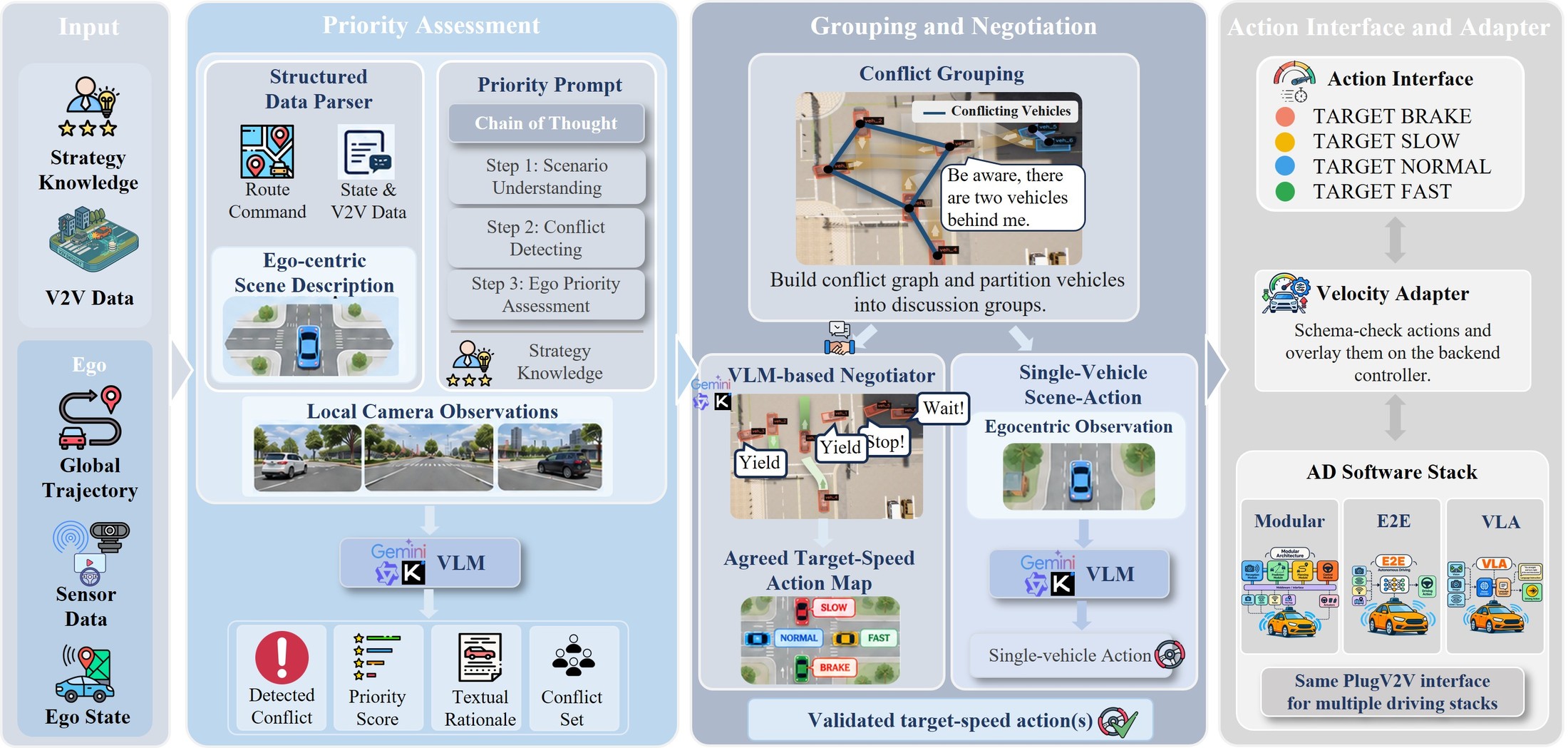
PlugV2V framework: priority assessment, grouping and negotiation, and the action interface and adapter that overlays validated target-speed actions on the host stack.
Overview of the framework. Priority assessment encodes each vehicle's route and received messages into a scene description and queries the model with it alongside that vehicle's own camera views, returning a local priority. Grouping and negotiation forms conflict groups, runs bounded discussion until a group agrees on a target-speed action map, and schema-checks the result; ungrouped vehicles take the single-vehicle scene-action path. Action interface and adapter overlays the validated actions on a rule-based, end-to-end or vision-language-action stack.

Each vehicle scores itself and names the neighbours it believes it conflicts with. Those reports are symmetrised into a graph whose connected components become independent negotiation groups, so vehicles that cannot affect each other never enter the same conversation. Members of a group exchange proposals for at most K rounds, and the agreement leaves as a single token.

TARGET_BRAKE TARGET_SLOW TARGET_NORMAL TARGET_FAST
H = 30 frames between cycles 0.67 Hz against a 20 Hz control loop K = 2 negotiation rounds R = 100 m cooperative range

Between cooperation cycles the host is in sole control. That is what makes the agent removable: unplugging it restores the unmodified stack rather than leaving a gap where a policy used to be.

04 — Results

92 closed-loop tests on InterDrive

CARLA 0.9.10.1 with the InterDrive multi-ego routes: 46 configurations across Town05–Town07, split into 18 intersection-crossing, 20 lane-merge and 8 lane-change cases. Each route runs with cooperative vehicles only and again with additional non-communicating traffic. Most routes use two connected vehicles, rising to six to eight in dense intersections and highway lane changes.

Comparison with the state of the art

Traffic
Split
MethodType DS ↑RC ↑ IS ↑SR ↑

Click a metric to sort; the split selector switches between the overall score and the three scenario families. DS driving score, RC route completion, IS infraction score, SR success rate; higher is better throughout. Competing numbers are as reported by their authors on the same benchmark; the rule-based, TCP and SimLingo rows are reproduced locally.

The parts are complementary

ConfigurationDS ↑RC ↑IS ↑SR ↑
Rule-based planner alone85.7294.120.910.73
+ single-vehicle query87.3694.320.930.63
+ cooperative observations78.5779.320.990.61
+ strategy knowledge87.4195.270.910.74
+ observations + strategy92.9795.750.970.74
+ grouping and negotiation (full)96.5796.571.000.87

Observations without strategy knowledge are safer but over-cautious — the agent sees the other vehicles but has no rule for who yields. The two only pay off together.

Backbone study

VLM backboneDS ↑RC ↑IS ↑SR ↑Serving
Hosted
gemini-2.5-flash96.5796.571.000.87API
kimi-k2.695.2695.451.000.85API
qwen3.7-plus93.2095.480.970.85API
qwen3.6-flash92.1297.540.940.83API
kimi-k2.589.8494.190.950.74API
Open-source · one consumer GPU
Qwen3-VL-8B86.5793.490.930.6516.3 GB
Qwen3-VL-4B84.1692.510.910.678.3 GB
Qwen3-VL-2B56.2059.100.960.484.0 GB

The smallest model does not fail at driving judgement so much as at holding the output schema: once a response cannot be validated the whole cooperation cycle aborts and every vehicle holds its previous token, which is why completion collapses while the infraction score stays high.

Driving score, route completion, infraction score and success rate for each host with and without PlugV2V.
Plug-in versus plug-out. The same agent, unchanged, attached to three different hosts. Only the small backend adapter differs.
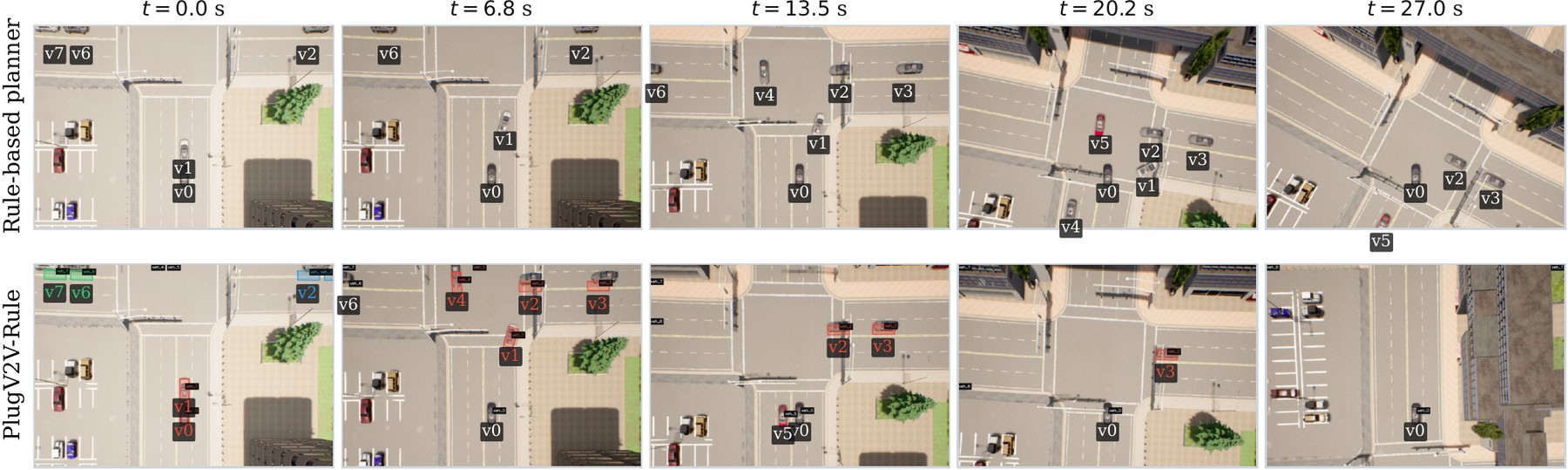
Five matched simulation times at an eight-vehicle intersection, with and without the agent attached.
What it does to traffic. One eight-vehicle intersection, five matched simulation times, agent removed (top) and attached (bottom). Both rows are the host's own bird's-eye output; colour marks a vehicle's conflict group and a vehicle in no group gets no box. Under a shared 6.5 m/s limit the planner alone crawls below 3.3 m/s, whereas the agent stops vehicles outright more often and then lets them cross at full speed. Explicit yielding replaces continuous crawling.
05 — Closed-loop runs

Watch it negotiate

Thirty scenarios from the InterDrive benchmark, five per category in each traffic condition, each shown twice: the rule-based host alone, and the same host with the agent attached. Both clips follow the same vehicle from the same spawn point, and both are the host's own bird's-eye output, recorded frame by frame during evaluation. Routes are those where the agent reaches a driving score of 95 or more, ordered by the gain over the planner alone; the chip suffix gives both scores. Backbone is qwen3.8:27b, a 27B open-weight model served on a single workstation.

Category
Traffic
Agent removed rule-based planner
Agent attached PlugV2V

06 — Citation

BibTeX

@inproceedings{plugv2v,
  title     = {PlugV2V: A Plug-In Vision-Language-Model-Based Semantic
               Cooperation Agent for Autonomous Driving},
  author    = {Anonymous},
  booktitle = {Under review},
  year      = {2027}
}